
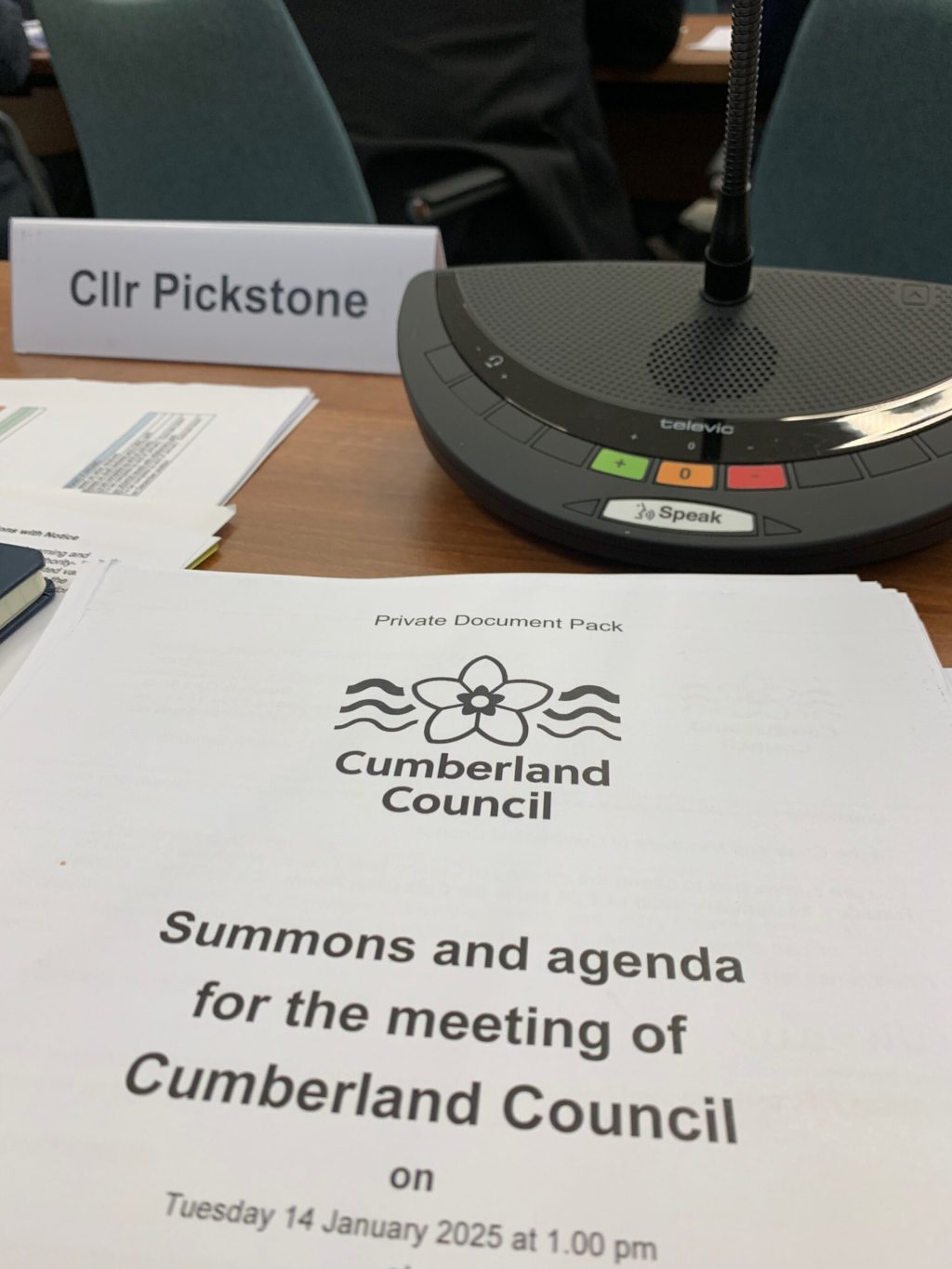
Last week was the regular meeting of Cumblerland’s Full Council. This is the meeting, 6 or 7 times a year, which is attended by all 46 councillors.

Waste Services Review
The Council consulted (over Christmas) on the future of waste collections across Cumberland. At present we have three, slightly different, waste collection services based on the former district councils in Carlisle, Allerdale and Copeland.
The Government is also bringing in standard requirements for waste collection services, so that all Councils offer the same basic system of what is collected.
The proposals for the future bring all the services in line, but mean some changes for everyone. The main change for us in the former Carlisle City Council areas is that our recycling bags and boxes will be replaced by two wheelie bins, and that there will be no garden waste collection at all over the winter months.
I raised some questions about the amount of expenditure that was taking place around the proposals. At the moment borrowing is expensive for local government (because of interest rates), and an external report into the Council’s finances last year expressed concern about the Council borrowing more money at the present time. The proposals mean about £14 million of borrowing on new bins and new lorries for the service in the future. This was agreed (I abstained, alongside the other Liberal Democrat councillors.)
Questions to the Cabinet
All Councillors can ask up to two questions to the Council Leader or another member of the Cabinet. My question this time was about school maintenance backlog. This is on the back of the former Cumbria County Council being restricted in the amount of maintenance it could afford over a number of years.
The answer was slightly dodged, as a condition survey is currently being undertaken to ascertain the level of maintenance needs in schools. I asked the Cabinet Member for Education what head teachers were saying to her about school maintenance backlog, but didn’t know (which I find a bit worrying.)
The questions and answers from me and there other Liberal Democrat councillors are here:
https://timpickstone.mycouncillor.org.uk/2025/01/31/answers-to-questions-january-2025/
Notices of Motion
I proposed a motion on Safer Phones for Children. This is on the back of a Private Members’ Bill, currently being drafted by the MP for Whitehaven and Workington about the need to bring in laws which make mobile phones safer for children to use.
According to Ofcom, nearly one in four children aged 5 to 7 now own a smartphone. By the age of 11, that figure skyrockets to nine in ten.
What is being considered in the Private Members Bill is bringing the Internet ‘age of majority’ to 16, which would mean that children could not sign up for their data being collected by social media companies, data which can then be used to target particular posts or advertising at children. I also wanted Cumberland Council to do more to work with schools who are supporting banning phones from schools.
The motion was carried, with the support of all parties, regrettably the lines which instructed the Council Chief Executive to write to the Government about the Council’s views were removed by Labour councillors – not quite sure what they are afraid of there!
There were two other notice of motions from other parties, both of which I supported. This was:
Asking the Government to think again on its Family Farm Tax proposals
- Asking the Council to think again about the delay in doing food waste collections.
- Asking the Governance to think again about the Family Farm Tax proposals.
The papers for the meeting are here. Please do not hesitate to get in touch if I can provide any further information.
https://cumberland.moderngov.co.uk/ieListDocuments.aspx?CId=311&MId=14240&Ver=4
Copy of Speech proposing the Safer Phones for Children Motion
Cllr Tim Pickstone – Speech Moving the Motion on Safer Phones for Children
Chair, Members,
I am delighted to be able to move today a motion on behalf of the Liberal Democrat Group on the important issue of safer phones for children.
This is an issue of critical importance to the future of children and the welbeing of society, and as such I hope it is one which can find all-party support here today.
The issue is particularly pertinent and timely for us here in Cumberland, as we are fortunately that one of our local MPs, Josh MacAlister, is using his high up placing on the House of Commons Private Members Bill Ballot to highlight and hopefully legislate on this issue. When we were discussion proposing this motion late last year, what we didn’t anticipate was that the issue would be even more timely by the time we got to full Council, with the recent antics of the owners of social media ‘giants’ Meta and X.
Mister Chair:
We are living in a digital age where technology is an integral part of our daily lives. Yet, as this motion highlights, the impact of smartphones and social media on our youngest and most vulnerable members of society is a matter of growing concern.
According to Ofcom, nearly one in four children aged 5 to 7 now own a smartphone. By the age of 11, that figure skyrockets to nine in ten. These devices, with their access to social media platforms are not without significant risks.
A growing body of evidence demonstrates the harm that smartphones and social media can inflict on children’s mental health, their ability to sleep, and their capacity to learn. Excessive screen time takes time away from vital real-world play and social interactions—activities essential for healthy development.
What’s more, the impacts are not equally distributed. Vulnerable children are disproportionately affected, exacerbating inequalities in mental health and development. This is a societal issue we can no longer afford to ignore.
We must also acknowledge the role of technology companies in this crisis. Health professionals and researchers have repeatedly highlighted how features designed to keep users engaged can foster addictive behaviours, making it harder for children to regulate their screen time.
According to the Smartphone Free Childhood campaign: Smartphones act as a gateway to pornography, violent and extreme content. Often children don’t seek them out but are exposed to them via algorithms and messaging apps. Once seen, these things can never be unseen. 90% of girls and 50% of boys say they’re sent explicit content they didn’t want to see.
Disagreements between pupils used to stop at the school gate, now they follow kids wherever they go, 24/7. Young people who experience cyberbullying are twice as likely to attempt suicide and self-harm. One in six teens report being cyberbullied in the past month, according to the World Health Organisation.
My personal view is that social media has a lot to answer for.
Only last week Mark Zuckerberg, CEO of Meta, the parent company of Facebook, WhatsApp, Instagram, and Threads announced it is removing third-party fact-checkers from its platforms, starting in the United States. Social media mega companies claim that their content relies on users checking facts, but one of the richest men in the world is able to use his platform to promote some very dangerous messages.
As adults we can make our own decisions about social media, but as a responsible society we need to take action to protect childen – we’ve made a decision as a society that it isn’t appropriate for children to buy alcohol, smoke, gamble, drive a car etc etc. It is time to do the same thing around harmful internet content.
This motion calls for decisive action. We must engage with and support the work of Josh MacAlister MP on his Private Members Bill. Raising the age of internet adulthood from 13 to 16 and strengthening Ofcom’s powers to protect children are essential steps toward safer digital spaces.
We must also ensure that our voice is heard by writing to the Secretary of State for Digital, Culture, Media, and Sport, and to our local MPs, urging them to prioritise this issue.
Locally, we can support schools in implementing policies to limit phone use during the school day. Many schools are already leading the way, and we must help them empower parents and pupils to navigate the internet safely.
We should also work with local partners to identify additional measures to support families in managing screen time and addressing the challenges of the digital environment.
Mister Chair, this is an important issue that I feel we have ignored for too long as a society and as a nation.
This is not just about protecting children from harm; it is about investing in their futures and the health of our society. By supporting this motion, we commit to action—locally, nationally, and globally—to address the digital challenges facing today’s children.
I urge you all to support this motion and help us create a safer, healthier, and more equitable digital environment for our young people.


Leave a Reply