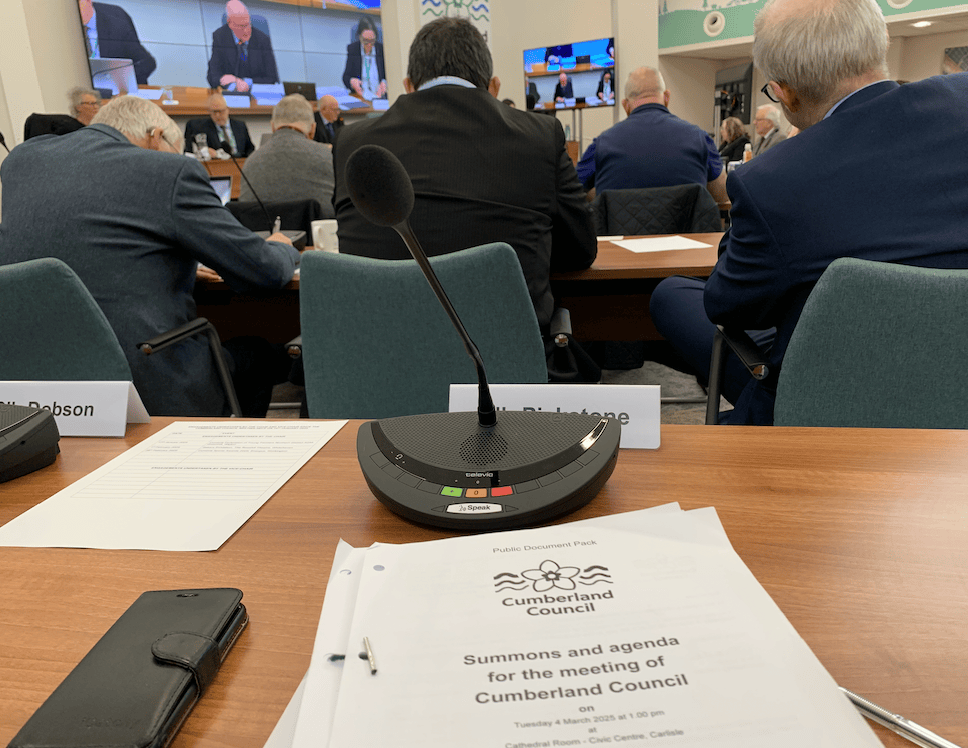
Earlier in the month was the Cumberland Council’s annual ‘Budget Council’. This is the important meeting each year where the Council sets its budget for the subsequent financial year, and the level of Council Tax which will be levied. The meeting consists of all 46 councillors, and we are legally required to set a balanced budget.
Background
Public sector finances continue to be very challenging across almost all areas. Local Government is particularly affected by increases in demand for services, which we are legally obliged to provide, where demand is increasing faster than income. This particularly applies to children’s and adult’s social services, but also services for children with special additional needs and disabilities (SEND).
Funding for local government comes from a number of sources:
- Council Tax on local residents (the Government has said that the maximum amount Council’s can increase Council Tax for 2025-26 is 2.99% + 2% for a social care precept (ie 4.99% overall).
- Business rates from local businesses.
- Grants from Government.
- Fees and charges.
The Government sets an amount which it thinks Cumberland Council should get in total called the Core Spending Power. This assumes that we increase Council Tax by the maximum amount.
For Cumberland increase in the Council’s core spending power was increased this year by around +5.8% in cash terms from £315.884m in 2024-25 to £334.244m in 2025-26.
This is significantly below the national average, which was 6.8%. The most significant factor in this was the complete removal by Government of the Rural Services Delivery Grant which has cost Cumbria as a whole around £12 million in lost funding this year.

What was agreed
Councillors agreed:
- To approve the General Fund budget for 2025-26 of £357,614,030.
- Approve Band D Council Tax in 2025-26 of £1,907.46 for Cumberland Council which
represents an increase of 4.99% on Council Tax levied across the Cumberland area
(2.99% increase in core council tax and 2% Adult Social Care precept). - Approve the capital programme 2024-to 2028 of £655,920,170, including £298,505,031
profiled for 2025/26. The most significant extra piece of expenditure in the Capital Programme was new money for the opening of new Children’s Homes, run by Cumberland Council, which we very much supported.

Exceptional Financial Support (EFS)
For the second year running Cumberland has asked the Government permission for Exceptional Financial Support. This means special permission to send £23.4 million on day to day spending by either borrowing more or selling assets. This EFS was granted – potentially right through to 2028 – because of the costs of local government reorganisation when Cumberland was created and 4 previous councils were abolished.
Liberal Democrat Proposals
Opposition Council Groups have the opportunity to propose amendments to the budget, which the Liberal Democrat Group always does.
This year our proposals were:
- To spend more money on school maintenance. For a lot of years Cumberland and before that Cumbria have maintained a policy of only really spending a basic amount on school repairs, meaning that some schools need some money spending on them to be fit for purpose. We proposed an extra £2 million over the course of two years.
- To spend more money on school attendance. As many people will be aware, school attendance since the pandemic has been a major problem, nationally but also in Cumberland. At the moment Cumberland employs less School Attendance Officers than is recommended nationally, so we proposed more money to bring this up to the national recommendation (2 extra school attendance officers).
- More money for community grants. Cumberland Council provides Community investment (grants) which are administered by the different Community Panels. This amount has not increased with inflation since the Council was set up, meaning less and less each year in real terms. We proposed an increase of 5% to make sure that the many community groups and projects that benefit from the investment are not missing out.
- Money to stream Council meetings. The vast majority of local councils in Britain ‘stream’ council meetings, and have done for many years. (IE allow members of the public to see what their councillors are doing in meetings by watching meetings online either live or at a later date). For some reason Cumberland doesn’t seem to be able to manage to do this, so we provided a small budget to get this happening this year.
Regrettably our proposals were voted down by both Labour and Conservative councillors. You can read my speech proposing the budget below.
Hope this is useful. The full papers for the meeting are here. Any questions don’t hesitate to ask.
Cllr Tim Pickstone – Speech Moving an Amendment to Cumberland Council’s
Chair,
I am delighted to propose this amendment to the budget on behalf of the Liberal Democrat Group.
Councillor Dobson will be seconding the amendment and adding further details to our proposals.
Before I begin, I want to place on record our sincere thanks to the Officers who have provided the information and costings needed to formulate this amendment, as well as to the Section 151 Officer for ensuring our proposal remains balanced despite the difficult financial circumstances we face.
Chair, this is the first time in 14 years, we are debating a Council budget under a Labour government.
What that means is for the last 14 years, we have listened to Councillor Cannor or her predecessors talk about the chronic underfunding of local government under the Conservatives. They told us councils like ours were being forced into impossible positions by Westminster decisions.
Now, they have the power to put things right. But what have we seen? Promises of investment have yet to translate into meaningful change for our communities. Cumberland’s funding settlement remains insufficient, our public services remain stretched, and we are still being asked to do more with less.
And yet, despite these promises, Cumbria is set to lose out on over £10 million in Rural Services Delivery Grant, which has been completely removed from local government funding from April 2025. Cumberland alone will lose over £3 million, Westmorland and Furness will see a £6.5 million cut, and Cumbria Fire Services will lose £500,000.
This decision is a direct attack on rural communities, ignoring the realities of delivering services across large, sparsely populated areas. Longer travel times, greater infrastructure challenges, and higher delivery costs mean that rural councils require additional support, not further cuts.
I represent Longtown Ward, one of the most rural wards in Cumbria, and can honestly say that I found this decision to be deeply disappointing and a betrayal of rural areas, whose needs have been completely disregarded by central government. If North Yorkshire Council is willing to take the Government to court over this, then why is Cumberland Council not fighting back?
Labour has an opportunity here to stand up for rural communities. If they reject this amendment, they must explain to the people of Cumberland why they are choosing to remain silent on this issue, rather than challenging the Government to restore vital funding.
It is also important that we recognise that we are one of the XXX local councils who are balancing their budget this year with Emergency (?) Financial Support – £xx million in Cumberland’s case. I think all of us understand the reasons why this is the case, having recently gone through local government reform, and I know that the Council’s leadership will be working hard to make sure that EFS is only a temporary ask from this Council.
- Schools Prioritised Maintenance Fund
Every child in Cumberland deserves to learn in a school that is safe, dry, and well-maintained. Yet, there remains a significant backlog of maintenance issues across our maintained schools. While schools receive funding for minor maintenance, the burden of major repairs—those exceeding £10,000 in primary schools and £27,000 in secondary schools—falls upon this Council.
The reality is that the School Condition Allocation from the Department for Education has been steadily declining. Under the previous government, this funding was cut year after year. Now that Labour is in power, will they restore it?
To ensure that school buildings remain safe, wind and watertight, we propose an additional investment of £2m over two years from April 1, 2026, targeting Priority 1 maintenance issues. This would be funded through capital borrowing, with an associated revenue cost of £200,000, redirected from a portion of the proposed increases in the Performance Team and PMO Assurance Role budgets.
I know the Council is currently undertaking an condition review to assess the state of our schools, which is why this proposal only begins in year 2 of this MTFS, to allow time for this study to take place, report back, and identify the most needed casds for investment.
2. ICT Kit to Stream Live Meetings
Transparency in decision-making is fundamental to public trust. During the Covid-19 pandemic, council meetings were live-streamed, setting a precedent for accessible democracy. However, since then, we have taken a step backwards in engaging the public.
It is now nearly three years since we debated this issue as a Council, but that general agreement has resulted in no action, leaving Cumberland as an outlier as someone who doesn’t stream any of its meetings.
We propose an investment in ICT equipment, staffing, and operational costs to reinstate live streaming of Council meetings. This would require £300,000 in capital borrowing and an annual revenue cost of £102,652.
This is our opportunity to prove it by ensuring the public can witness the decisions that affect their lives.
3. Increasing Access and Inclusion Officers
School attendance and safeguarding are among our most pressing priorities. Currently, our Access and Inclusion team operates with just five full-time equivalent officers, well below the Department for Education’s recommended 7.4 officers for attendance work alone.
Under Section 436A of the Education Act 1996, local authorities must identify children missing from education. To fulfil this duty effectively, we must strengthen our team with two additional officers at a cost of £102,000. This will ensure that vulnerable children do not fall through the cracks and receive the education and safeguarding support they need.
4. Community Panel Budget Increase
Our Community Panels play a crucial role in supporting local initiatives and addressing grassroots issues. However, since their establishment in 2023, their budgets have remained static despite inflation, reducing their real spending power.
We propose a 5% increase in the Community Panel budget, equating to an additional £36,348 in recurring funding from 2025/26. This modest uplift will help sustain local projects that directly benefit our communities.
Funding These Proposals: A Question of Priorities
To fund these vital proposals, we must make difficult but necessary decisions regarding the Council’s internal staffing budget. The Council already employs a substantial number of Performance Officers (17) and Project Management Officers (13). These teams should be capable of absorbing future responsibilities without additional funding.
The proposed increase in budget for the Performance Team (£435,000) will be reduced to £217,000, and the budget for the PMO Assurance Role (£248,000) will be reduced to £124,000. This will free up £435,000, allowing us to redirect funds to frontline services where they are most needed.
In Conclusion
This amendment does not increase the Council’s overall spending, it simply prioritises investment where it has the greatest impact: in our schools, in our communities, and in democratic transparency.
This is a responsible, balanced, and necessary adjustment to ensure we are delivering for the people of Cumberland.
I urge Members to support this amendment and demonstrate our commitment to the future of our children, our communities, and our democracy.


Leave a Reply