
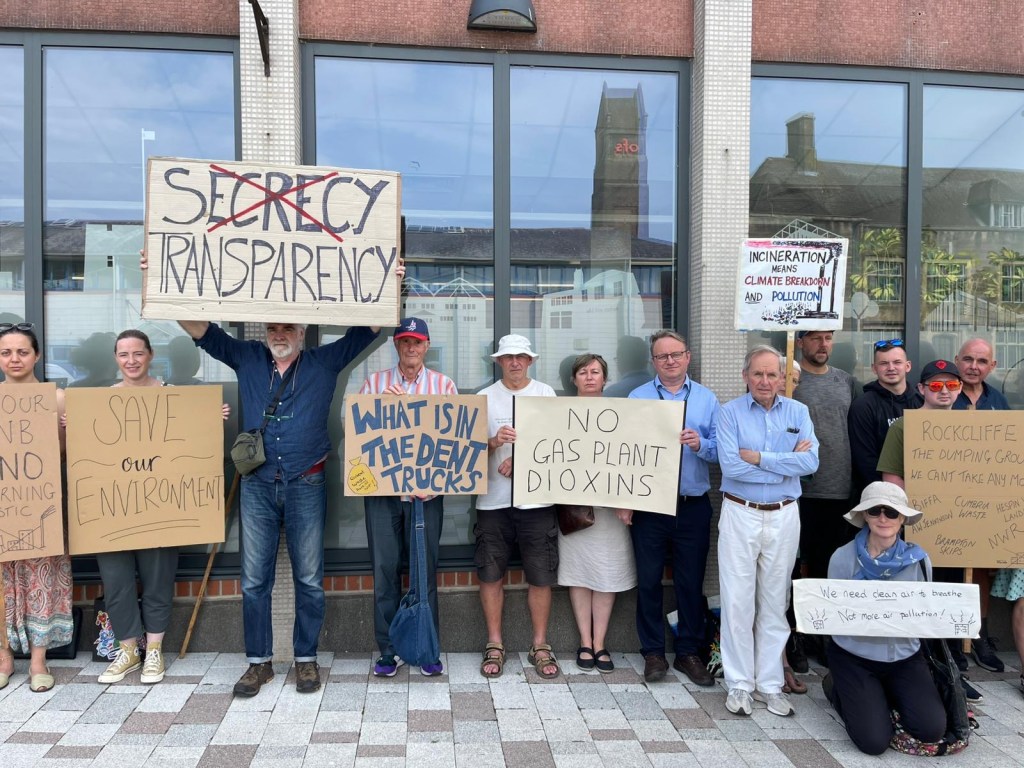
Friday was the special meeting of the Planning Committee to consider the application for a plastics gasification plant at the North West Recycling site just south of Rockcliffe village.
It was great to see so many local residents outside to protest, many of whom were able to watch the meeting. Five local residents and/or campaigners addressed the meeting, as did the Chair of Rockcliffe Parish Council and myself as the local councillor. My speech is below.
The recommendation from Council Officers was to approve the application.
Thank fully members of the Committee didn’t agree and the application was refused by 5 votes to 2.
Papers for the meeting are here.
Councillor Pickstone
Objection Speech
Thank you, Chair, and thank you for the opportunity to speak today.
My name is Tim Pickstone, and I’m the local councillor for Longtown Ward, which includes the village of Rockcliffe. I am here today to object, in the strongest possible terms, to this planning application.
Chair, Rockcliffe is a beautiful, historic village at the top of the Solway Firth. But it has already taken far more than its fair share of energy and waste development—particularly waste and energy infrastructure.
In recent years, Rockcliffe Parish has seen a significant expansion of waste and energy facilities and proposals within one small parish: the expansion of the Hespin Wood Waste Management Park, bringing a major increase in waste processing and lorry traffic. We now have a massively expanded Harker Substation, multiple battery storage and solar farm proposals either approved or pending, a consented Waste-to-Energy incinerator just down the road—and now this: a tyre pyrolysis plant proposed less than a kilometre from the current site.
Chair, no one could look at this situation objectively and say it is fair. The cumulative impact is simply too much for one small rural community to bear. If Cumberland were to develop – and perhaps we should – a waste and energy strategy, there is no way that it would identify one small village north of Carlisle for five major waste and energy schemes.
There’s also real concern about lorry movements on the small roads in Rockclife and next door Kingmoor parishes, but also the already congested junction 44 roundabout and ASDA roundabout. 26,000 tonnes a year will be required to run this gasification plant, 2000-2500 lorry movements a year, presumably many from far afield, on our roads even if the lorries are returning empty.
Air pollution is another major concern. Just this week, the Royal College of Physicians reported that 500 people in the UK die every day as a result of poor air quality. This application proposes burning synthetic gas around the clock, releasing harmful pollutants like dioxins, which are known to damage human health and enter the agricultural food chain. Officers showed us the maps earlier, but I would remind members that air pollution is cumulative and here we are considering unnecessarily adding a new polluter.
Very nearby residents, as John excellently described are very affected. But, the prevailing wind blows up the Solway and eastward across Cumberland. The potential impact on health and agriculture stretches well beyond Rockcliffe itself.
Chair, I can report to you as the local councillor that local residents have longstanding concerns about this operator. In 2021, 400 tonnes of plastic caught fire on this site and burned for weeks. Residents were instructed to stay indoors and keep windows closed. Since then, I’ve received further complaints—about litter, non-compliance with planning conditions, for example just this week complaints concerning operations outside of approved hours from previous planning permissions.
Environmental risks extend beyond the site boundaries. The Solway Coast National Landscape—the only National Landscape entirely within Cumberland—is an immediate neighbour. The upper Solway is internationally important for its marine and bird life, much of it rare or endangered. And the surrounding salt marshes are vital carbon stores. The WWF recently warned we’ve already lost 85% of Britain’s salt marshes. We can’t afford to lose more.
The River Eden—a Site of Special Scientific Interest and major wildlife corridor—is only 500 metres away. During the 2021 fire, firefighters had to scale back their response due to fears of causing an environmental disaster in the Eden.
Chair, both the Solway Firth National Landscape and Cumbria Wildlife Trust—respected and expert organisations—have submitted objections to this proposal, and I believe their concerns should carry significant weight. The applicants might be proposing to purchase credits from elsewhere to offset their biodiversity impact, but ultimately there is only one river Eden and only one upper Solway Firth, and they are in our stewardship.
Finally Chair, I also believe this proposal contradicts both national waste policy and our own Climate and Nature Strategy.
The waste hierarchy places burning waste (and that is essentially what gasification is) at the bottom—as a last resort, the thing we should do least of. National policy is moving away from incineration, except where there is proven and exceptional need. A recent BBC report identified incineration as the dirtiest form of electricity generation—now that coal is no longer in use.
And every year, we make real progress reducing unrecyclable waste—whether through cutting plastic packaging or improving recycling technology. That is the direction we should be going in—not locking ourselves into a plant built for waste that we’re working hard to eliminate.
On the planning balance, most of the positive benefits were described as limited or very limited. Only one was ‘significantly’ positive is there is a need for the facility and that it is moving waste up the ‘waste hierarchy. I would challenge both of these assumptions, because this is absolutely not moving waste up the waste hierarchy – it is moving it down, and challenge the demand going forwards as technology and the way we produce waste is reduced.
The renewable energy production is so minor so that it scores less that significant and all all other benefits are either very limited, so on planning grounds I fail to see why you need to approve this application.
Not only is this clearly the wrong location. It places a disproportionate burden on one small community, risks harm through noise, traffic, and air pollution, and threatens some of Cumberland’s most sensitive and treasured environments and habitats.
Thank you, Chair.


Leave a Reply